

Visualising an Invisible Roofing Problem for Masons NZ
Moisture build-up in modern roof spaces is one of those problems that can quietly cause serious long-term damage, without ever being seen. Changes in construction methods, tighter building envelopes, and increased insulation have improved energy efficiency, but they have also made roof cavities far more susceptible to trapped moisture and condensation.
To help Masons NZ Ltd clearly communicate both the problem and their solution, we developed a 3D animation that brings roof ventilation science into view.
Turning building science into something you can see
One of the biggest challenges in explaining condensation issues is that the mechanics are largely invisible. Airflow, moisture movement, and temperature differentials are hard to grasp through text or static imagery alone, especially for audiences without a technical background. Our brief was to make these forces visible.
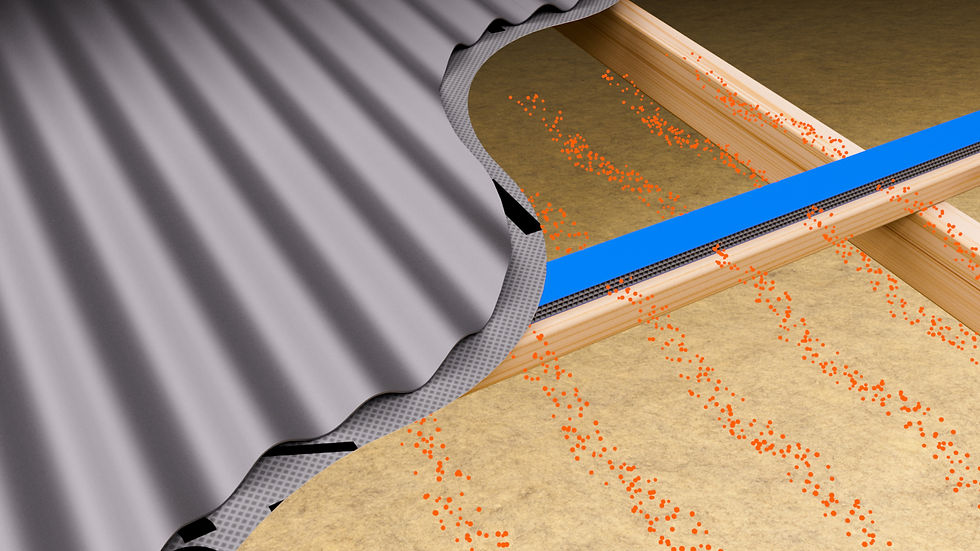
Using a simplified but accurate roof cavity model, we visualised how air behaves inside a typical unvented roof space. Viewers can see moisture becoming trapped, pooling, and circulating internally, creating conditions that lead to corrosion, mould growth, and reduced material lifespan.


We then contrast this with the same roof using Masons’ Passive Roof Ventilation System, clearly showing how continuous airflow allows moisture to escape naturally. By placing the two scenarios side-by-side, the benefits of passive ventilation become immediately clear without relying on heavy technical explanation.

A balance of realism and clarity
The animation approach deliberately sits between realism and diagrammatic clarity. Detailed 3D renders ground the content in familiar building forms, while simplified motion graphics, cutaways, and airflow indicators help guide the viewer through the story.
This balance allows complex performance characteristics to be communicated quickly and intuitively, making the animation suitable for a wide range of uses, from sales conversations and presentations through to online education and product marketing.


From technical detail to clear storytelling
At its core, this project was about translating technical performance into a clear, engaging narrative. Rather than overwhelming the audience with data, the animation focuses on cause and effect: what happens without ventilation, what changes when airflow is introduced, and why that matters over time.
The result is a piece of content that supports Masons’ technical credibility while remaining accessible to builders, specifiers, and decision-makers alike.
This project is a good example of how 3D visualisation can be used not just to show products, but to explain systems, performance, and long-term value in a way that words alone cannot.


.jpg)